


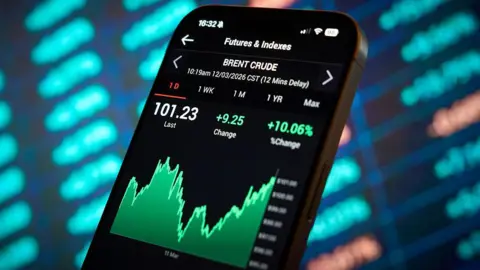
It is often difficult to determine what is influencing Donald Trump one month after the US and Israel's campaign of military action on Iran.
However, it remains evident he has his attention fixed on the oil markets.
A word – or online message – from the US president regarding his plans used to spark significant moves in prices, as market participants reacted to signs the conflict could worsen or conclude.
However, in the last week, traders are showing signs of growing more sceptical about the significance of his remarks.
The price of oil was trading at approximately $72 a barrel (bbl) prior to 28 February, when the military action against Iran began.
Last week, it reached a high of $118 a barrel on 19 March and by Friday afternoon was valued at just below $112 – markedly higher than its pre-war price.
Below are some moments from the last month where Trump and the markets seem to have bounced off one another – with varying impacts.
Navigate with the navigation button to move to the following chart.
"Oil prices have become a proxy for broader geopolitical and economic risks, surging when Trump's tone becomes aggressive and easing when his language de-escalates," observes one financial expert.
He continues that markets are appropriately sensitive to those signals, considering the big financial dangers that are associated with rising oil prices.
"Traders are trying to assess authentic uncertainty," he says. "The markets can look skittish or uncertain, but what they're actually doing is navigating geopolitical risk in live, with oil positioned directly at the core of that."
However, it can be tough for investors to decide how to trade, particularly because a portion of Trump's remarks appear intended to affecting oil prices, instead of articulating official strategy, notes another market commentator.
"As the saying goes, the first casualty of war is truth," he observes. "My belief is much of the rhetoric trading of statements around productive talks, and the contrary, very much are centred around just moving the market price of oil."
Investor Response Grow More Tempered
On Thursday, minutes after US stock markets recorded their sharpest fall since the outset of the Iran war, Trump said discussions with Iran were going "extremely well" and he was putting off planned attacks on Iran's energy infrastructure until at least 6 April.
But, the price of crude proceeded to rise.
One market analyst explains that market reactions are "becoming more muted" because of the "huge gap" between Trump's optimistic statements and the absence of confirmation from Tehran.
"Given the optics, many market watchers cannot envision an quick conclusion to the hostilities and markets remain anxious."
Another investment director says markets have also grown used to Trump "frequently shifting position at indications of political, equity market or financial stress".
"We are seeing a amount of scepticism, or even frank suspicion, taking hold at the margins," he concludes.


